

South America
Welcome Kit
Ecuador
A very attractive destination; its four worlds: Coast, Andes, Amazon and Galapagos allow tourists to enjoy wonderful landscapes and beaches; added to all this majestic churches, heritage buildings and cities and gastronomic diversity.
A Paradise in the center of the world, multi-ethnic and multicultural!
Highlights
This beautiful country is a paradise everywhere you look at it.
Discover the Best Preserve Historic Center in South America.
Fall in love with its views, beaches and the abundance of fauna. Increase your adrenaline with a variety of adventure sports that Ecuador has to offer.
Do not forget to delight yourself with the taste of its gastronomic diversity, which you’ll find while touring this country full of magic and charm.
General Facts
Named the same as Parallel 0º, Ecuador is located on the terrestrial equatorial line, for which its territory is found in both hemispheres.
Home to a wide variety of endemic species, which at the time have been the subject of studies by the English naturalist Charles Darwin, which led to the materialization of the theory of evolution by natural selection. The islands have gained worldwide fame due to the particularity of their fauna, especially the tortoises known as “Galapagos”.
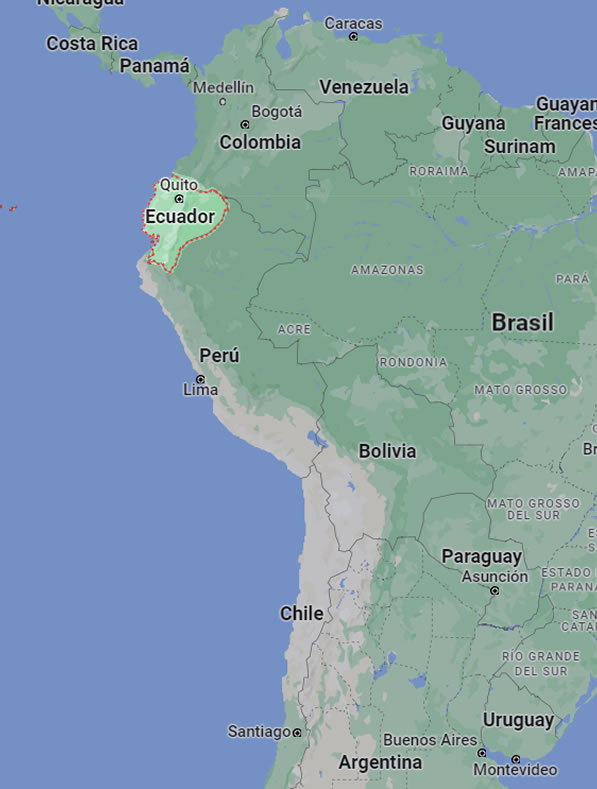
Although covering just 256,370 sq. km. (110,000 sq. miles) Ecuador contains one of the most varied geographies in South America. There are four distinct regions: the Andean highlands, the coastal tropical plains, the Amazon Basin and the Galapagos Islands, located 1,000 km. (600 miles) off the coast in the Pacific Ocean. Quito, on the highlands, is the capital city; Guayaquil, on the coast, is the main port and the largest city in the country.
Map Location
Documentation
Valid passports are required for entry into Ecuador. No visas are needed for stays of up to 90 days. Before landing, your airline will give you an embarkation/disembarkation card to be filled out and presented to the Immigration officer.
Best Time to Go
The best time to travel to Ecuador varies depending on the region of the country are you going to. If you are planning to visit the beaches the best season is surprisingly the rainy one, that takes place from December through to May as this is a lot fresher than the dry season from June to November which can be way too cool as well as cloudy. But now, most people prefer dry and sunny days, which means one of the best times to travel to Ecuador is often considered to be the months of June through September. This is certainly the time when you can be more certain of enjoying superb panoramic views of Ecuador’s grand mountains and volcanoes.
The Andes (july-aug)
Best time for excursions. Busy season.
More expensive prices. Sunny and warm days in the Andes.
The Amazon (aug-nov)
Best time to discover the wilder side.
In general, it’s hot and humid. Expect some rain, mosquitoes for sure.
The Coast (may-dec)
Best time to take advantage of thermal baths. Visit some of the country’s indigenous villages.
Between June and Sept, humpback whales appear off the coast of Puerto López, ideal for boat trips.
The Galapagos (june-aug)
Best time to trek on the islands. Particularly cold, you will need a wetsuit if you want to snorkel or go diving.
Busy season. Prices are higher.
Clothing
Dressing in layers is ideal, the day really heats up.
Lightweight woolens are ideal for the highlands they are a good choice to wear against your skin as it naturally helps to regulate your body temperature; and warm jackets are essential after dusk at high altitudes.
Cotton for the Amazon, Pacific lowlands and Galapagos. Dress is informal. Do not forget swimming wear and comfortable walking shoes.
Healthcare
Altitude Sickness
It is not unusual in the mountains.
Take it easy and try not to do anything too strenuous.
Check with your doctor before coming if in doubt.
Packing
Ecuatorian flights allow, as their restrictions are limited to 50 pounds (23 kg) per person.
Currency
American dollar.
Major credit cards are widely accepted.
Electricity
Ecuador: 120 V – 60 Hz.
Easy to find power adapters and voltage regulators.
Plugs Type A and B
Local Taxes
Foodie
International cuisine is available throughout the country, but try some of the Ecuadorian specialties:
Llapingachos: they are fried tortillas made with boiled potatoes and stuffed with cheese, usually served with a delicious peanut sauce, chorizo, fried egg, salad, and avocado. This is one of the dishes that foreign tourists enjoy the most, so we recommend you try it while you’re there.
Ceviche: it is one of the most traditional dishes in Ecuador, especially on the coast of the country. Although shrimp ceviche is very popular (since Ecuador has high-quality shrimp), ceviches made with snail, fish, and other seafood are also famous. While seafood ceviche is the most sought after, there are some variations prepared with beans, heart of palm, mushrooms, among other ingredients, in an attempt to make it a great vegetarian option.
Locro de papa: a delicious potato stew that can include cheese and corn, served with avocado and toasted corn. It has a creamy consistency and its incomparable flavor makes this soup a true delicacy that must be tried if you are visiting Ecuador. In fact, if it doesn’t have cheese or meat, it is an excellent vegetarian option or a healthy vegan alternative.
Roasted guinea pig: also known as “guinea pig” or “cavy,” it is an animal food product consumed in Andean countries. In fact, dishes like roasted guinea pig and guinea pig stew are part of Ecuadorian culinary heritage. Roasted guinea pig is usually served with potatoes and/or corn, sauce, and chili.
Encebollado: it is a dish commonly cooked to relieve hangovers and is also called “chuchaqui” in Ecuador. Encebollado is a fish-based broth (made with white tuna) that
also contains yuca, tomato, onion, bell pepper, and other ingredients. This dish is usually served with popcorn, chifles (thin strips of fried green plantain), toasted corn, or bread. You cannot miss this traditional dish during your stay in the country.
Foodie Advice >>
Get suggestions from foodies around South America. Click title to read more!
Activities
Cotopaxi National Park: With vast plains, rocky mountain trails, and crystal-clear lagoons, Ecuador’s largest and most visited national park is a spectacular setting for outdoor adventure. Located along the Pacific Ring of Fire, Cotopaxi National Park is most famous for the highly photographed Cotopaxi volcano, the highest active volcano in South America.
Cotopaxi Volcano: It is one of the most famous peaks in South America and Ecuador’s most active volcano, perhaps the most recognizable landmark along Ecuador’s Avenue of the Volcanoes. On a clear day, you can see the snow-covered cone from Quito, but a closer exploration requires a trip to Cotopaxi National Park.
Mindo Cloud Forest: Spanning over 48,000 acres (19,200 hectares) and rising to an altitude of 15,700 feet (4,778 meters), the Mindo Cloud Forest, part of the Mindo-Nambillo Ecological Reserve, is one of the most biologically diverse forests in the world.
Santa Cruz Island: It is easily the most central island for Galapagos visitors. Welcoming overnight guests (only four of the islands do), it can serve as the perfect base of operations from which you can explore the islands. Although not the largest, it is certainly the most popular urban center. However, in addition to being the most cosmopolitan, Santa Cruz also offers beautiful beaches and wildlife.
Middle of the World Monument: It commemorates the site where 18th-century French explorer Charles Marie de la Condamine once calculated the equatorial line of the globe. A trapezoidal monument in the center of the park houses an observation platform; a small museum on the equator pays tribute to local indigenous cultures.
Quilotoa Lagoon: It formed when an extinct volcano collapsed and the resulting crater filled with a stunning emerald green lake, the color resulting from volcanic minerals. Just south of Quito, the village and Quilotoa Lagoon have become a popular destination for day trips, offering spectacular views and photo opportunities.
Casa del Árbol Swing: in the Ecuadorian highlands on the outskirts of Baños, Casa del Árbol Swing is a seismic monitoring station that has capitalized on its perfect location atop a mountain next to the Tungurahua volcano by installing a treehouse with a rope swing. “The Swing at the End of the World,” as it is often called, offers thrills with a clear view of the volcano.
Basilica del Voto Nacional: It is one of the most beautiful Roman Catholic churches in Quito. Set on a hill and visible from nearly anywhere in the city, it is particularly striking after dark when it is illuminated. The Neo-Gothic decoration has an interesting twist: it features gargoyles and ornaments representing local animals such as armadillos, iguanas, pumas, monkeys, turtles, and condors. The abundant artwork also includes bronze statues, stained glass windows, and impressive stone carvings.