

South America
Welcome Kit
Bolivia
Uyuni
Located in southwestern Bolivia, Uyuni is the gateway to one of the planet’s most surreal natural wonders: the Salar de Uyuni. This small, quiet town serves as the starting point for unforgettable adventures across infinite white landscapes, mirror-like reflections during the rainy season, and otherworldly desert scenery. Visiting Uyuni is more than a trip—it’s a journey into a dreamlike world shaped by nature and Andean culture.
Highlights
If you visit Uyuni, don’t miss the chance to stand on the endless white expanse of the Salar de Uyuni, the largest salt flat in the world.
In the rainy season, the flats transform into a giant mirror, creating one of the most magical landscapes on Earth.
Explore Incahuasi Island, a cactus-covered hill rising dramatically from the salt desert.
Visit the haunting Train Cemetery, where rusted locomotives rest in the desert.
For those seeking even more adventure, multi-day expeditions into the Eduardo Avaroa Reserve offer flamingo-filled lagoons, geysers, stone forests, and remote thermal springs.
General Facts
Uyuni is a Bolivian town best known as the access point to the world-famous salt flats. Here are some key facts about this destination:
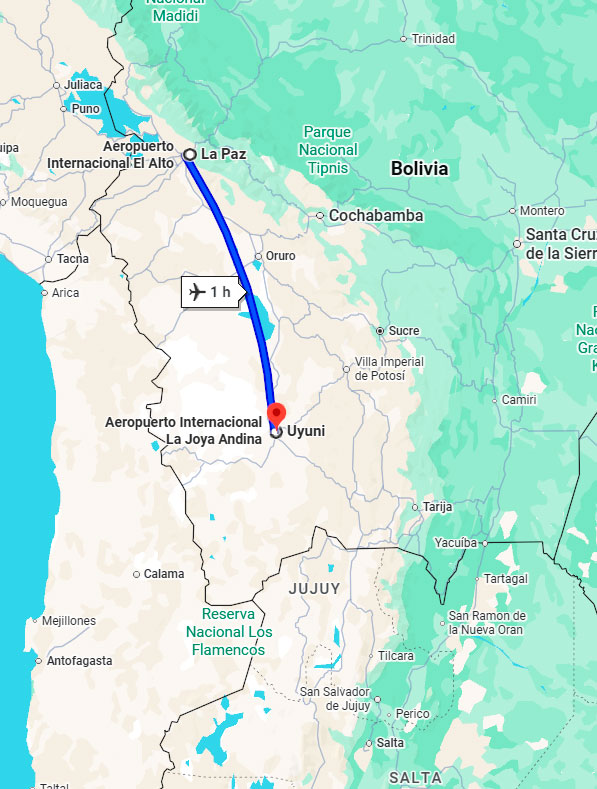
Location: Southwestern Bolivia, near the borders with Chile and Argentina, at the edge of the Altiplano.
Altitude: 3,660 meters (12,008 ft) above sea level.
Founding: Established in 1890 as a major railway junction connecting Bolivia with Chile and Argentina.
Accessibility: Uyuni is served by Joya Andina Airport (UYU), with flights from La Paz. It is also reachable by long-distance bus or by road from San Pedro de Atacama (Chile).
Map Location
Documentation
A valid Passport. Insurance information.
Most countries in America and Western Europe do not require a visa.
Best Time to Go
The best time to visit Uyuni depends on the experience you want:
May to November – Dry Season:
Crystal-clear salt patterns and full access to most areas. Ideal for photography.
December to April – Wet Season:
The salt flat becomes a spectacular mirror after rainfall. Some routes may be restricted.
Tip: Sunrise, sunset, and stargazing experiences are exceptional all year due to high altitude and low light pollution.
Clothing
Uyuni’s high-altitude desert climate means cold nights and strong sun during the day.
Bring:
- Warm layers (thermal jacket, fleece, gloves, scarf, beanie)
- Comfortable walking shoes
- Sunglasses, sunscreen, hat
- A windbreaker or waterproof layer (especially in rainy season)
Tip: Temperatures drop sharply at night—dress in layers even in summer.
Healthcare
Altitude Sicknes
It is not unusual in the Andes.
Take it easy when you visit the Puna and try not to do anything too strenuous.
Check with your doctor before coming if in doubt.
Packing
Bolivian flights allow, as their restrictions are limited to 50 pounds (23 kg) per person.
Currency
Boliviano.
Major credit cards are widely accepted.
Electricity
Bolivia: 220 V – 60 Hz.
Some older buildings in La Paz still use 110 V. Plugs Type C / F.
Local Taxes
Foodie
Uyuni’s cuisine reflects Andean ingredients and high-altitude traditions:
Quinoa: A staple in soups, stews, and side dishes.
Llama meat: Lean and flavorful, served grilled or in stews.
Sopa de Maní (peanut soup): Creamy, hearty, and comforting.
Foodie Advice >>
Get suggestions from foodies around South America. Click title to read more!
Activities
Uyuni offers one-of-a-kind natural and cultural experiences:
Explore Salar de Uyuni:
A must-see full-day or multi-day adventure across the world’s largest salt flat.
Mirror effect in rainy season:
Walk across a perfect reflection of the sky—an unforgettable sight.
Sunrise, sunset & stargazing:
The salt flat offers ideal conditions for spectacular sky views.
Incahuasi Island:
Hike among giant cacti with panoramic views.
Train Cemetery:
An iconic open-air museum of rusted locomotives.
Eduardo Avaroa National Reserve:
See colorful lagoons, geysers, Andean wildlife, and desert landscapes.
Cultural encounters:
Learn about traditional salt harvesting and Andean customs in local communities.